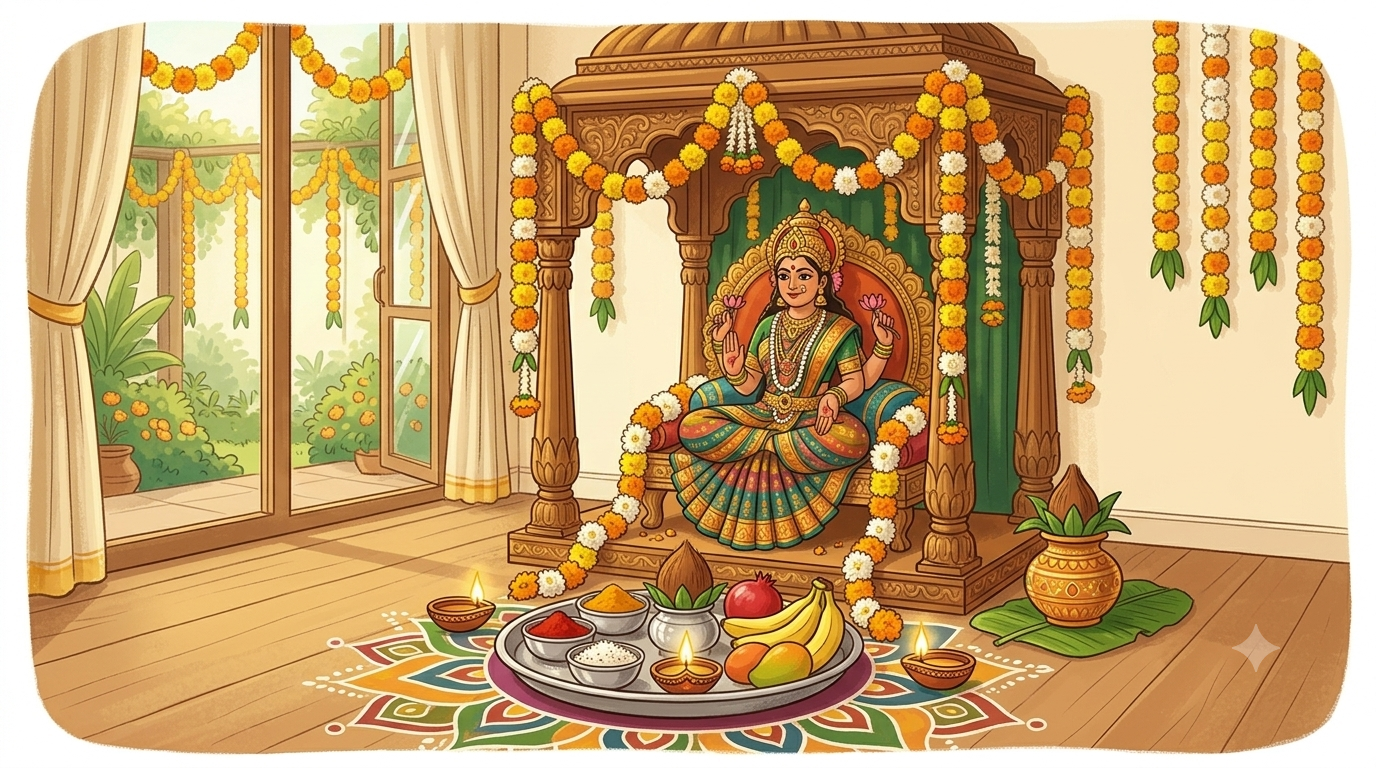
Have you ever seen a home transformed into a beautiful little temple?
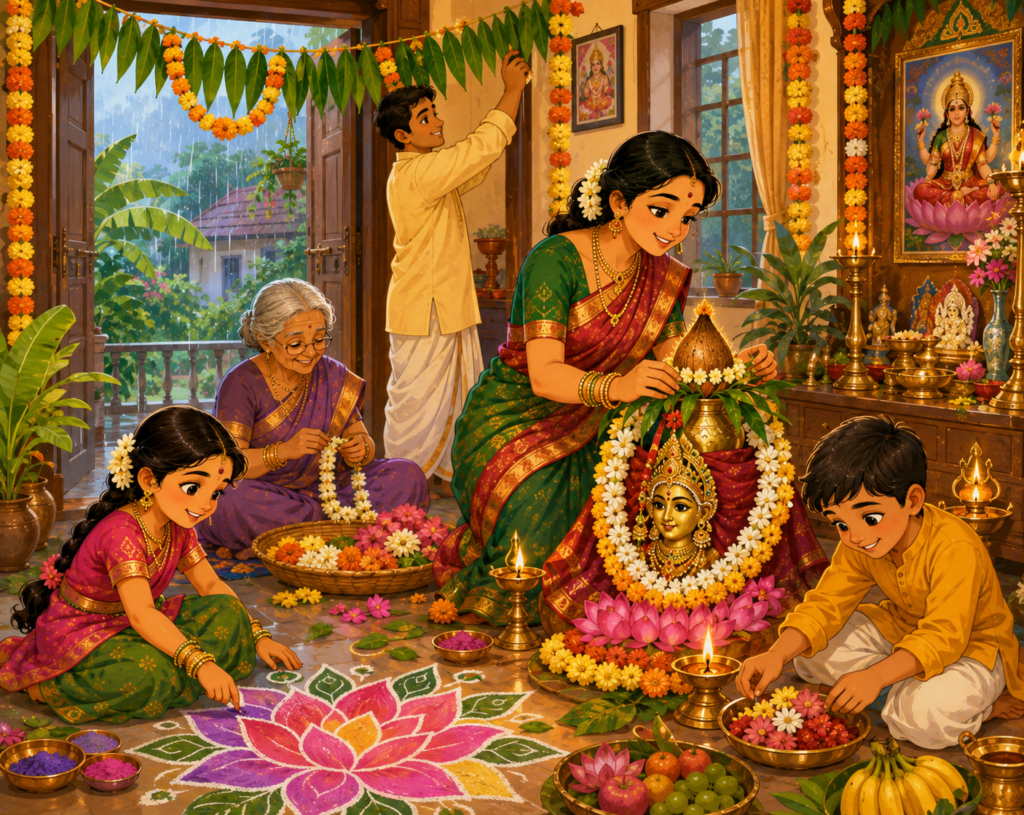
On Varamahalakshmi, homes across South India are decorated with flowers, mango leaves, rangoli and glowing lamps. A beautiful kalasha is dressed up as Goddess Lakshmi, delicious food is prepared, and family and friends come together to pray and celebrate.
But who is Varamahalakshmi?
Why do people worship her?
And what are all those beautiful decorations and rituals about?
Let’s find out!
The Story of Charumathi
Long ago, there lived a kind and devoted woman named Charumathi.
Charumathi loved her family and was known for caring for her home and respecting her elders. She was also a devoted worshipper of Goddess Lakshmi.
One night, something wonderful happened.
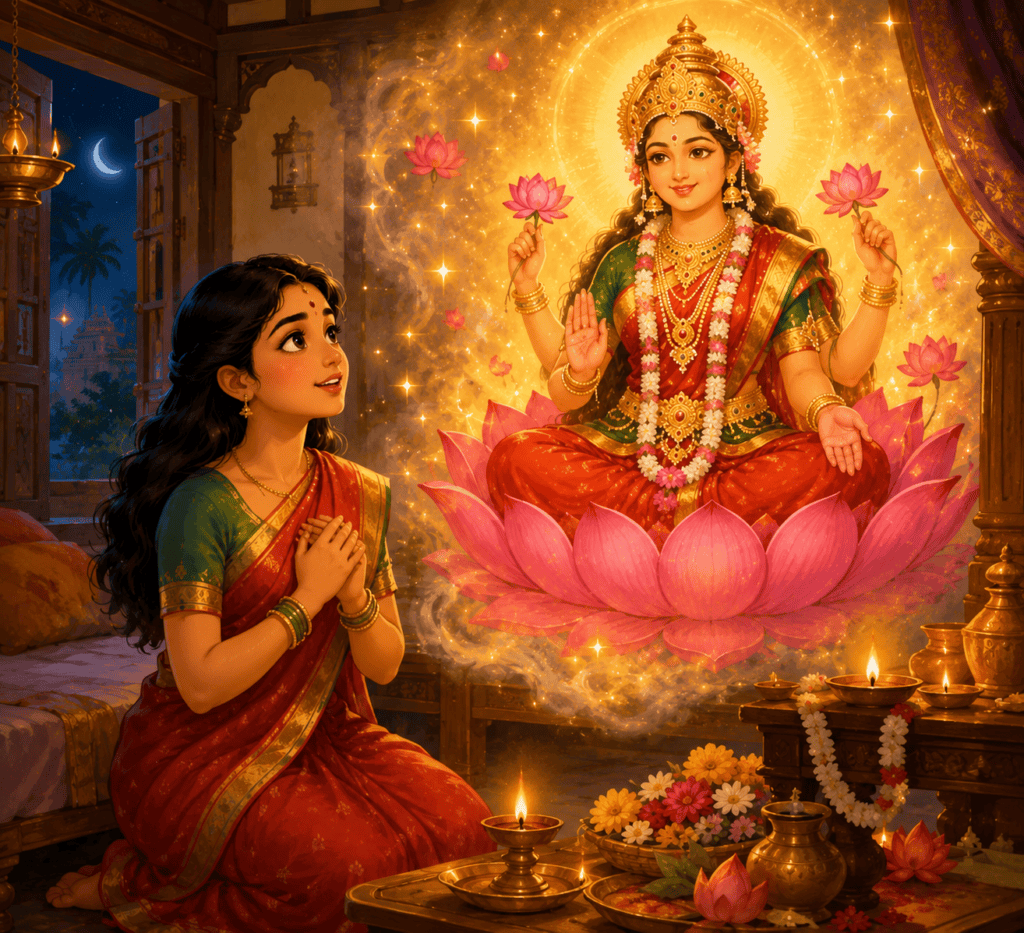
Goddess Lakshmi appeared to Charumathi in a dream.
The goddess told her about a special worship called Varalakshmi Vratham and asked her to observe it on an auspicious Friday during the month of Shravana.
When Charumathi woke up, she told her family about the dream.
Her family supported her, and Charumathi invited other women from her town to join her.
Together, they cleaned and decorated their homes, prepared the puja and worshipped Goddess Varalakshmi with flowers, lamps and offerings.
According to the traditional story, Goddess Lakshmi blessed Charumathi, her family and everyone who took part in the worship with prosperity and well-being.
And that is why the story of Charumathi is one of the best-known stories connected with Varamahalakshmi.
💡 If Goddess Lakshmi appeared in your dream, what would you ask her?
Why Do We Celebrate Varamahalakshmi?
The word “Vara” means a boon, blessing or gift.
So Varalakshmi is understood as Goddess Lakshmi in her form as the giver of blessings.
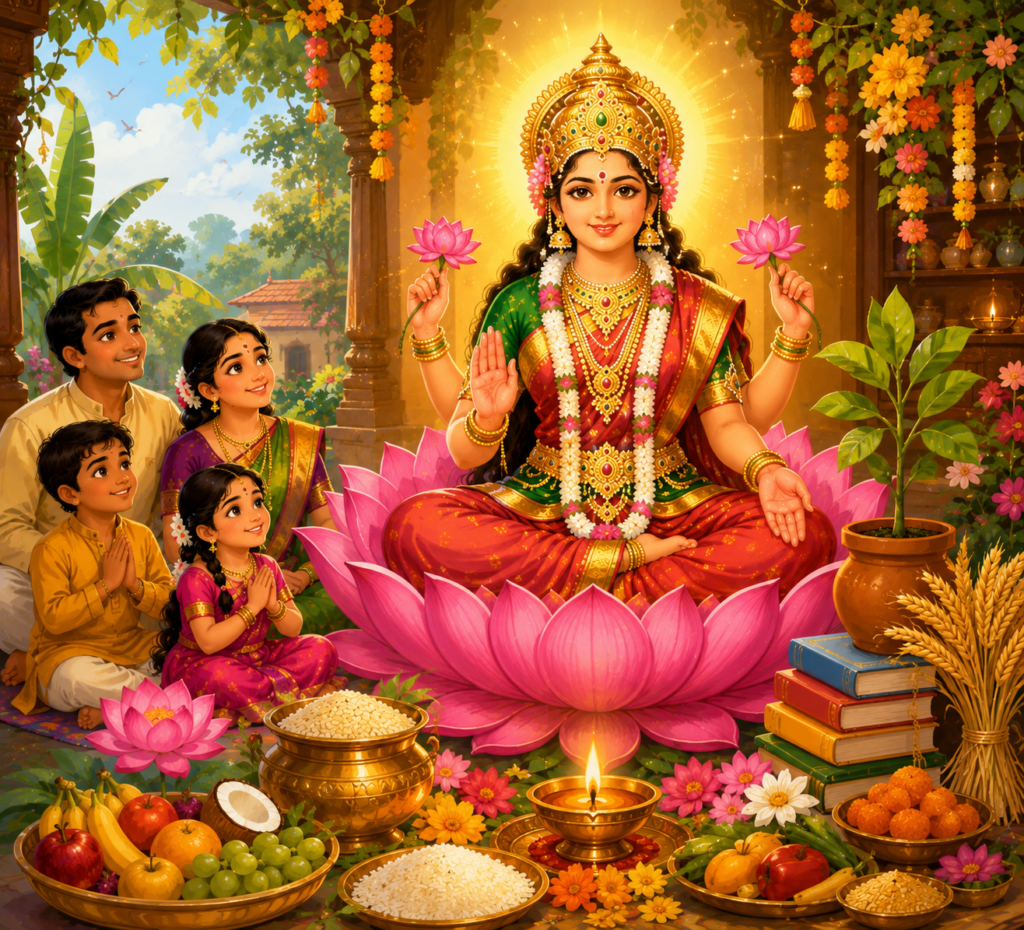
Goddess Lakshmi is associated with prosperity and abundance, but prosperity does not only mean money.
It can also mean having:
❤️ a loving family
🏠 a happy home
🍚 enough food
📚 knowledge
💪 strength
🌱 well-being
🤝 good friends
🕊️ peace
The festival is traditionally observed especially by women praying for the well-being and prosperity of their families.
It is also a beautiful reminder for everyone – including children – to be grateful for what we have and generous towards others.
💡 If you could choose one blessing for your family, what would it be?
The Beautiful Kalasha
One of the most special parts of Varamahalakshmi is the kalasha.
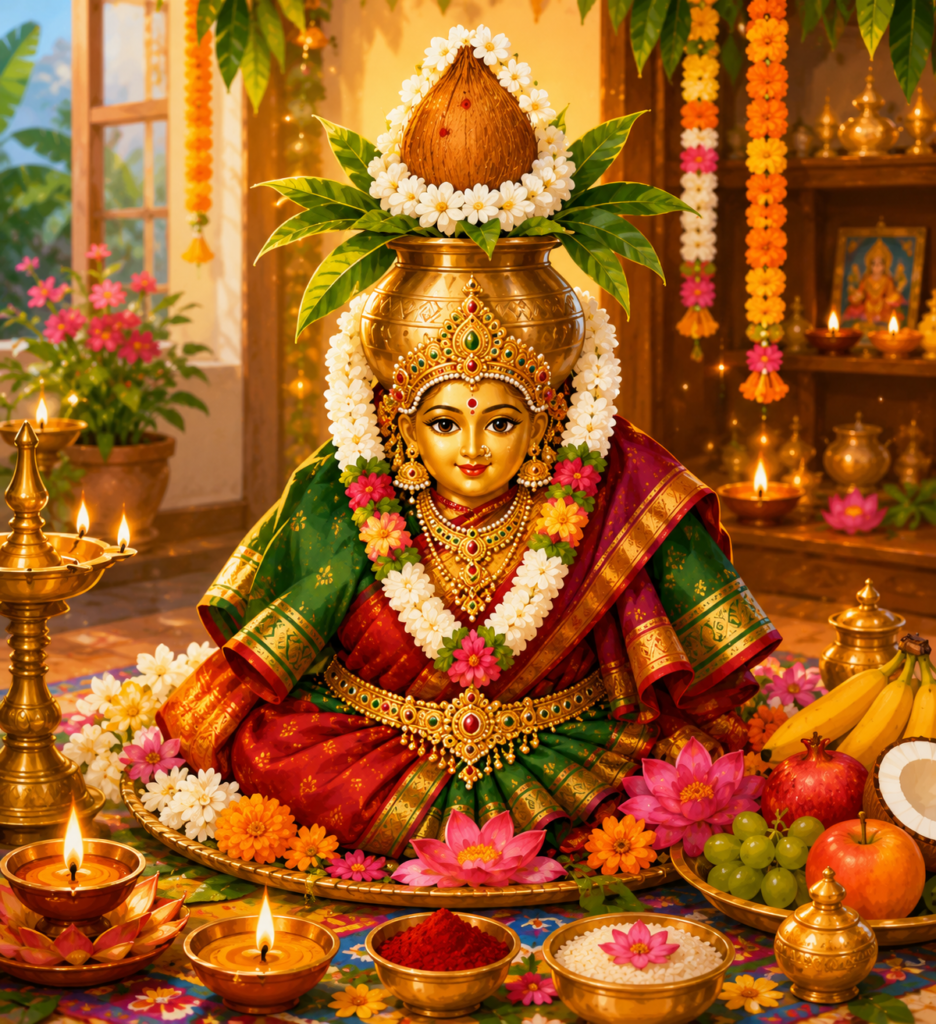
A sacred pot is prepared and decorated with rice, mango leaves and a coconut.
In many homes, the kalasha is beautifully dressed as Goddess Lakshmi. A sari, jewellery, flowers and sometimes a special Lakshmi face are added to make it look like the goddess herself has come home to bless the family.
The kalasha becomes the centre of the puja.
Two More Stories People Tell
The story of Charumathi is the most commonly told story connected with Varalakshmi Vratham.
But there are other traditional stories associated with the festival too!
Let’s look at two of them.
The Story of Shyamabala
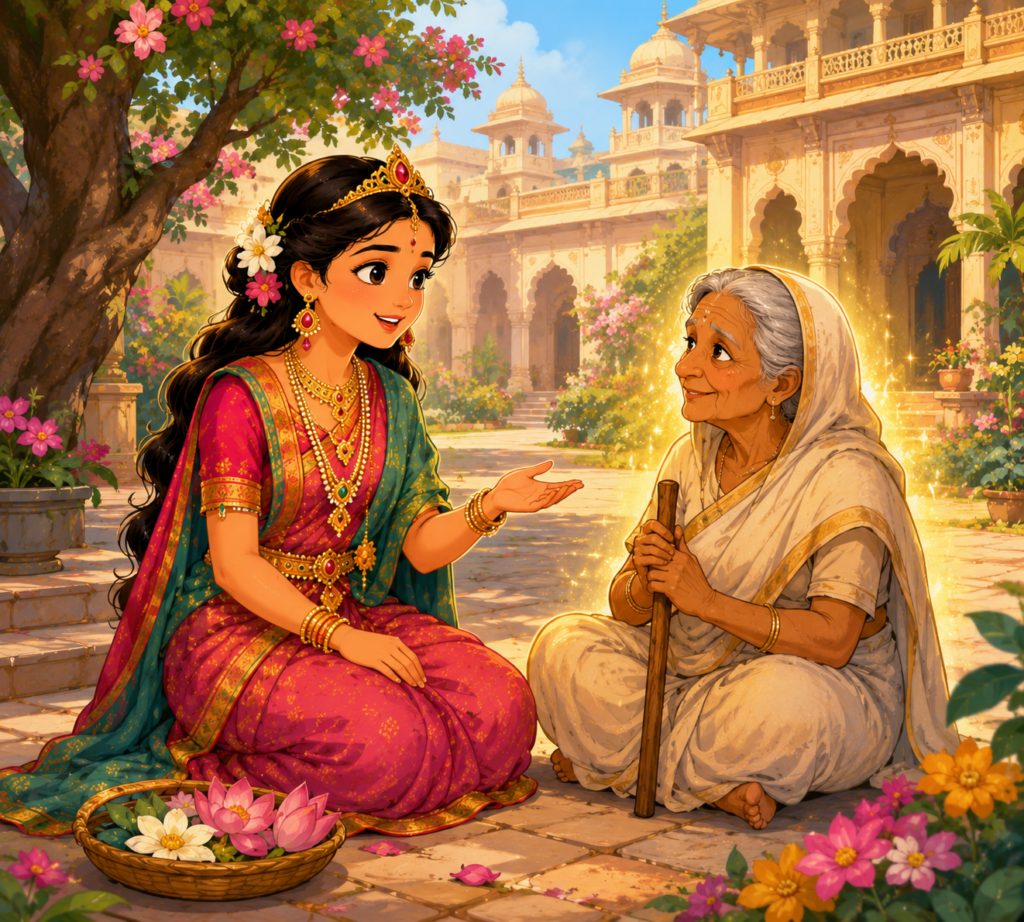
Once there lived a princess named Shyamabala.
One day, while visiting her parents’ palace, Shyamabala saw an old woman speaking to her mother, the queen.
The old woman told the queen about the importance of worshipping Goddess Varalakshmi.
But the queen was not happy to hear advice from someone who looked poor and simply dressed.
She sent the old woman away.
Shyamabala felt sorry for her.
She welcomed the woman and listened to what she had to say.
Later, Shyamabala followed the old woman’s advice and performed the Varalakshmi worship.
According to the story, prosperity came to Shyamabala’s kingdom.
But her parents’ kingdom began to suffer.
When Shyamabala sent pots of gold to help them, something strange happened.
The gold turned into ashes when her mother saw it.
Shyamabala realised that her mother’s unkindness towards the old woman had brought this trouble.
She understood that the old woman was believed to have been Goddess Lakshmi in disguise.
Her mother asked for forgiveness and began worshipping Goddess Lakshmi with devotion.
According to the story, prosperity returned to the kingdom.
💡 Should we judge someone by their clothes or appearance? Why not?
The Story of Chitranemi
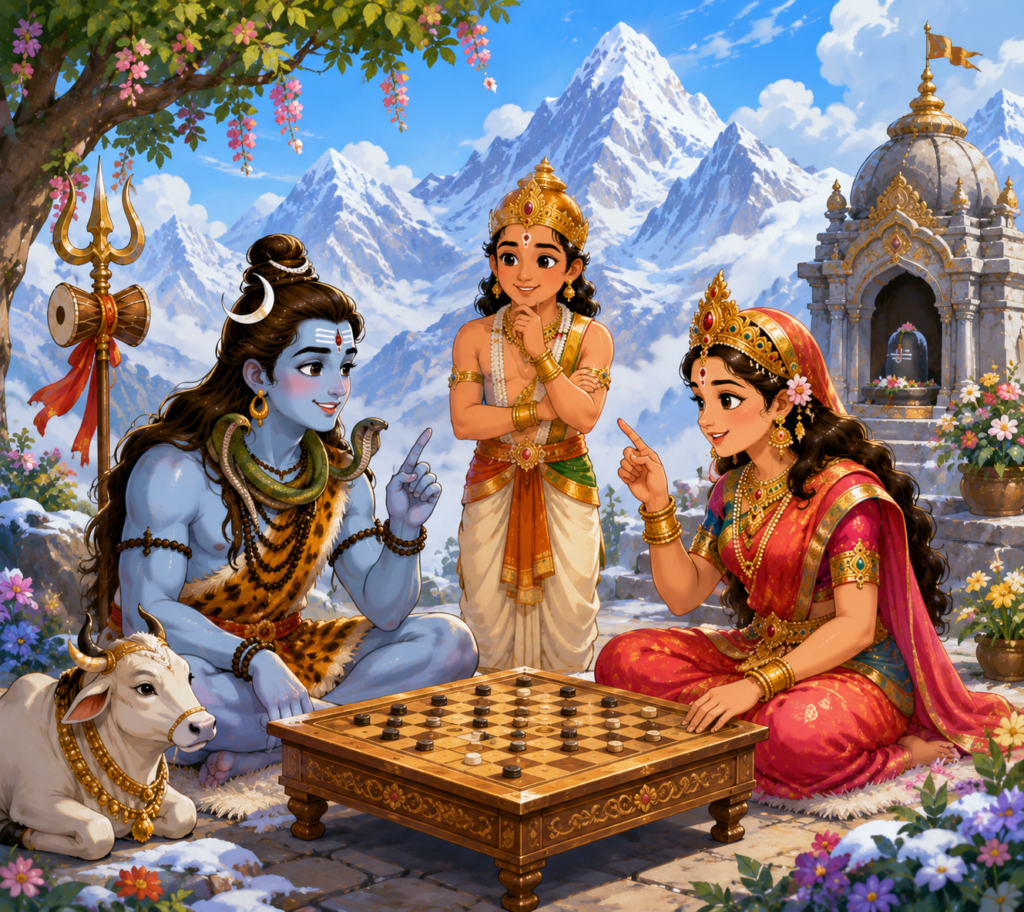
There is another traditional story involving Lord Shiva, Goddess Parvati and Chitranemi.
One day, Shiva and Parvati were playing a game.
They disagreed about who had won and asked Chitranemi to decide.
Chitranemi was one of Shiva’s attendants.
But instead of giving a fair answer, he declared Shiva the winner.
Parvati was upset because she believed Chitranemi had not told the truth.
According to the traditional story, she cursed him.
Later, Shiva asked Parvati to forgive him.
Parvati agreed, but Chitranemi had to take part in the worship of Goddess Varalakshmi.
He followed the tradition with devotion and was eventually freed from the curse.
This story reminds us of something very important:
Always try to be truthful and fair.
💡 If you were the judge, would you choose your friend or tell the truth?
How Is Varamahalakshmi Celebrated?
There is lots to do before the puja begins!
🧹 Clean the Home
Families clean their homes and especially the place where the puja will take place.
🎨 Make a Rangoli
Beautiful rangoli or kolam designs are drawn near the entrance or puja area.
Lotus designs are especially popular.
🌸 Decorate the Home
Mango leaves, marigold flowers and other fresh flowers are used to decorate doorways and the puja area.
🪷 Prepare the Kalasha
The kalasha is filled and decorated as Goddess Lakshmi.
🪔 Perform the Puja
Families offer flowers, fruits, sweets, lamps and other offerings while prayers are recited.
🧵 Tie the Sacred Thread
In many traditions, a sacred thread is worshipped and tied around the wrist after the puja.
💐 Share With Others
Friends, relatives and neighbours may visit one another, exchange flowers, sweets and tambulam, and share prasadam
How Is It Celebrated Across India?
Varamahalakshmi is especially popular in Karnataka, Andhra Pradesh, Telangana and Tamil Nadu, with related traditions also found in other regions and among Indian communities around the world.
The festival may have different names and slightly different customs depending on the family and region.
Here are a few examples!
Karnataka – Varamahalakshmi Habba
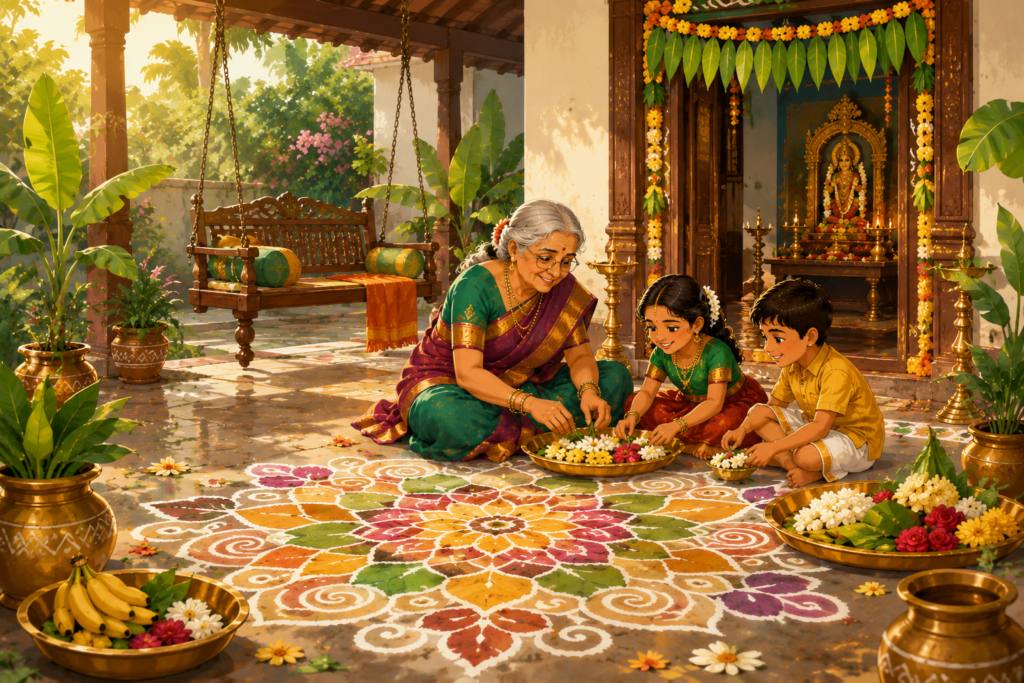
In Karnataka, the festival is popularly known as Varamahalakshmi Habba.
Homes are decorated with rangoli, mango leaves, flowers and lamps.
The kalasha is often dressed beautifully as Goddess Lakshmi.
Families prepare festive foods such as obbattu, kosambari, puliyogare and payasa.
Women may also visit one another and exchange sweets, flowers and tambulam.
Andhra Pradesh & Telangana – Varalakshmi Vratam
In Andhra Pradesh and Telangana, the festival is commonly called Varalakshmi Vratam or Varalakshmi Nomu.
The kalasha may be decorated very elaborately as Goddess Lakshmi.
Women often invite friends and relatives and exchange tambulam and prasadam.
Traditional foods vary from family to family, but festive rice dishes, sweets, payasam and savouries are commonly prepared.
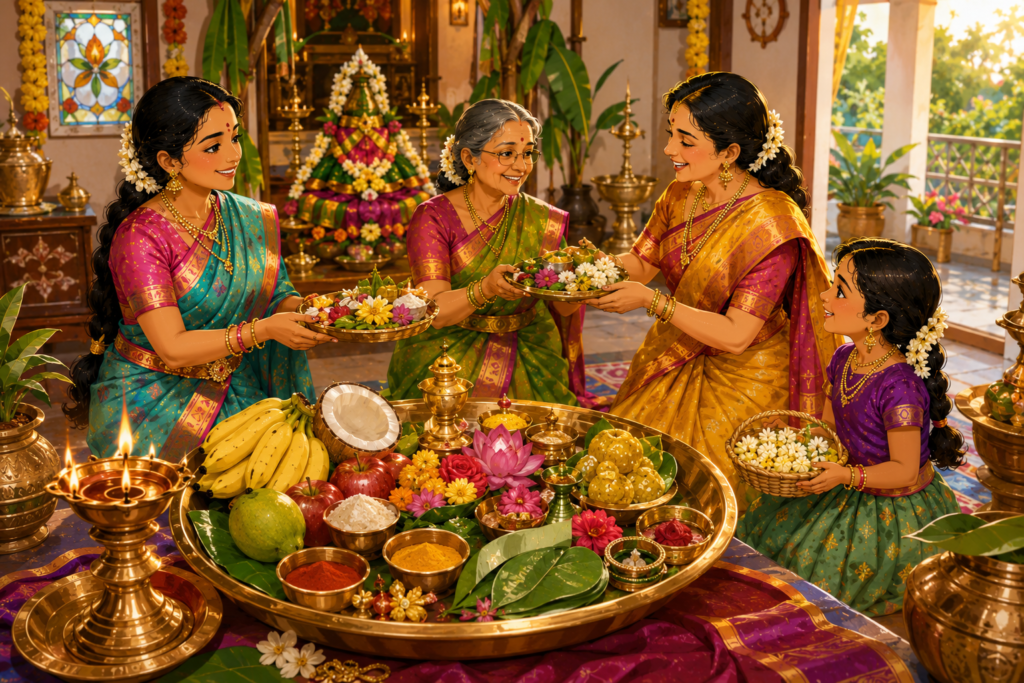
Tamil Nadu – Varalakshmi Nombu
In Tamil Nadu, the festival is commonly called Varalakshmi Nombu or Varalakshmi Pooja.
Homes may have beautiful kolam designs at the entrance.
Women decorate the puja space with flowers, lamps and a beautifully dressed kalasha.
Families prepare different festive dishes according to their traditions, including sweets and savouries.
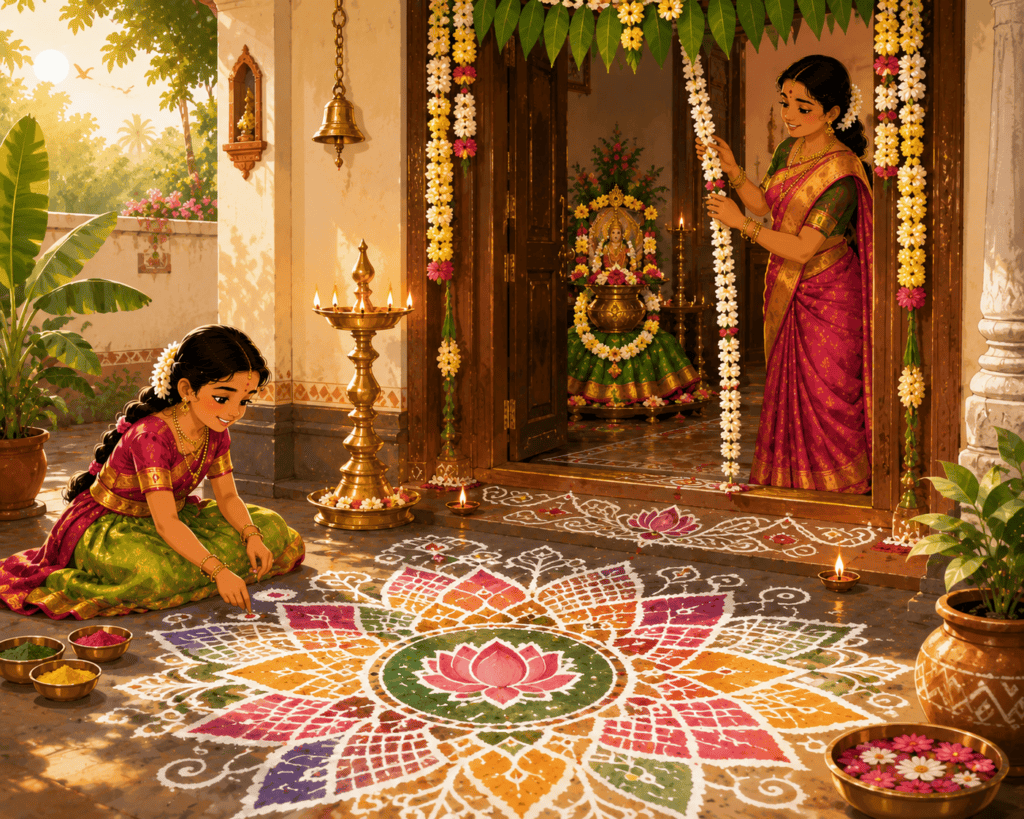
💡 Would you like to celebrate Varamahalakshmi with all these beautiful decorations? Which one would you make first – the rangoli, flowers or kalasha?
What Do People Eat on Varamahalakshmi
Every family has its own favourite festive dishes!
Depending on the region and family tradition, the meal may include:
🥥 Kozhukattai
🍚 Puliyogare
🌱 Kosambari
🥨 Vada
🍯 Payasam
🌾 Obbattu
🍚 Huli Anna
🍬 Sweets and savouries
The menu can be very different from one family to another – and that’s part of the fun!
In Karnataka, for example, obbattu, kosambari, puliyogare, huli anna and hesarubele payasa are among the foods associated with the celebration
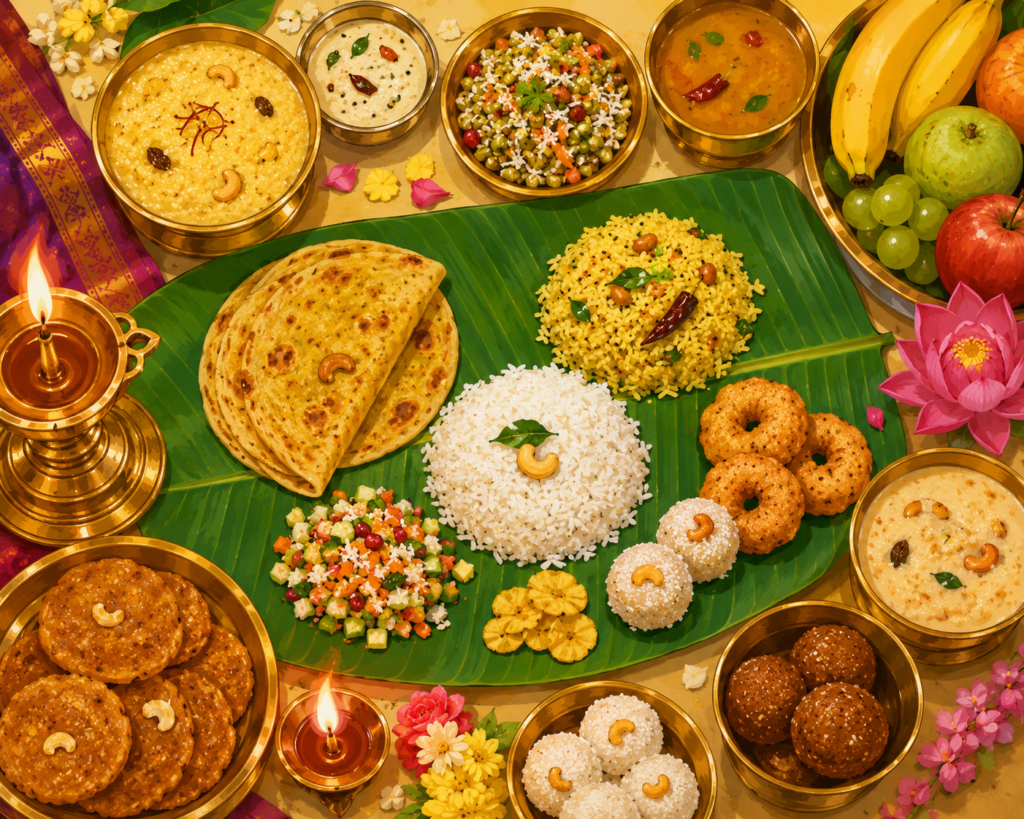
💡 Which of these would you most like to taste?
Make Sweet Coconut Aval – A Simple Festive Recipe
Want to make something festive at home?
Try this easy sweet coconut aval.
It’s simple enough for children to help with – but remember, a grown-up should handle the stove!
What You Need
- 1 cup aval / poha
- ½ cup grated coconut
- ¼–½ cup jaggery
- 2–3 tablespoons water
- 2 cardamom pods, powdered
- 1 teaspoon ghee
- A few cashews or raisins, optional
What to Do
Step 1: Soften the aval
Wash the aval gently and drain it. Leave it for about 5 minutes to soften.
Step 2: Melt the jaggery
Ask a grown-up to heat the jaggery with a little water until it melts.
Step 3: Add the coconut
Add the grated coconut and mix.
Step 4: Add the aval
Add the softened aval and mix everything together.
Step 5: Add the flavour
Mix in the cardamom powder and ghee.
Step 6: Finish it!
Add some cashews or raisins if you like.
Your sweet coconut aval is ready!
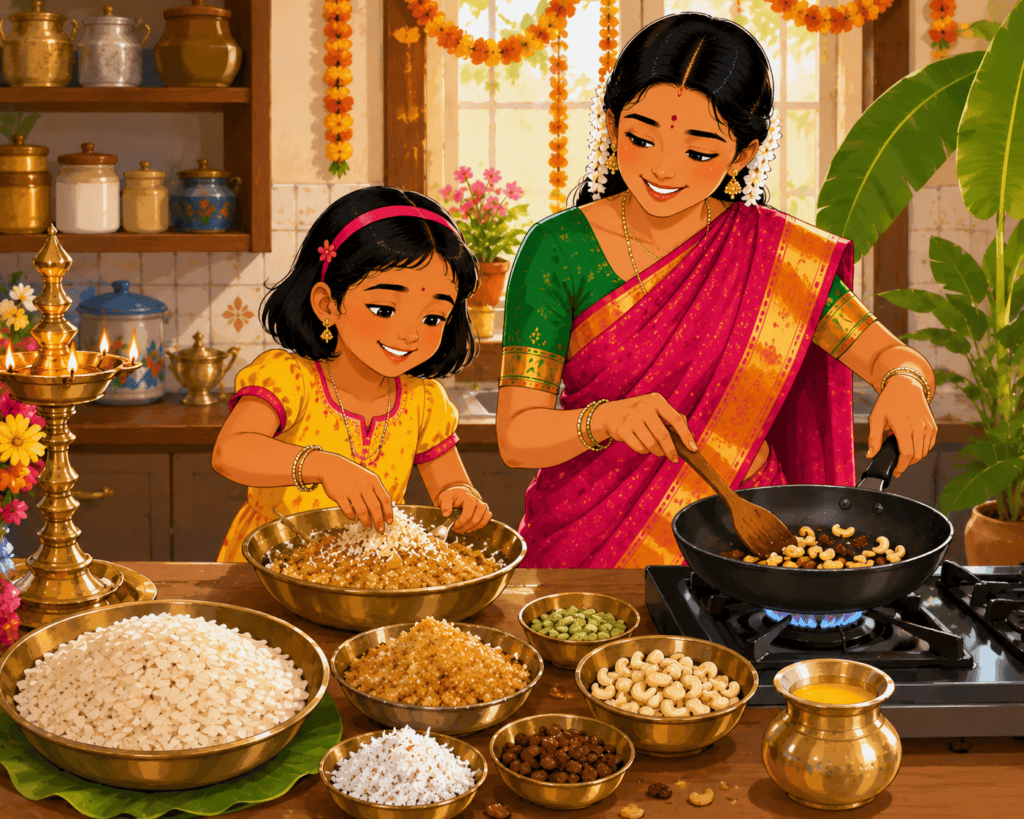
💡 Would you add cashews, raisins or both?
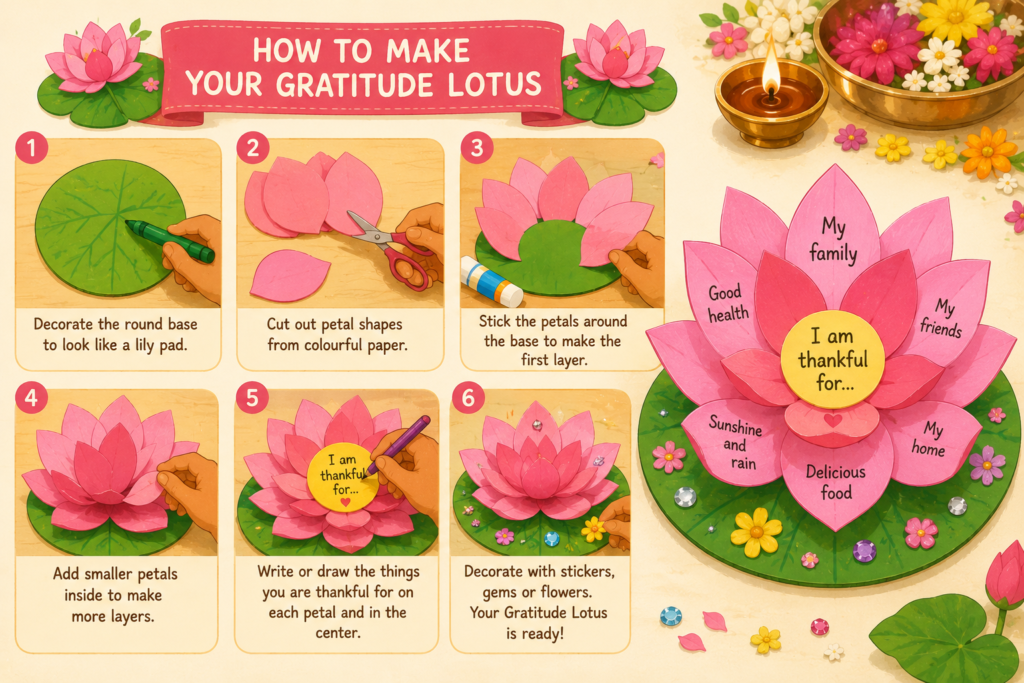
Fun Activity – Make Your Own Gratitude Lotus!
Goddess Lakshmi is often shown with a beautiful lotus.
So let’s make our own!
But this lotus has a special secret.
Every petal will hold something you are thankful for.
What You Need
- Paper
- Pencil
- Crayons or colour pencils
- Scissors
- Glue
- Optional stickers or glitter
What To Do
1. Draw a big lotus.
Draw a simple flower with lots of petals.
2. Colour it.
Use pink, red, purple, yellow – or any colours you love!
3. Cut it out.
Ask a grown-up to help if you need scissors.
4. Fill the petals.
On each petal, draw or write something you are grateful for.
You could choose:
❤️ My family
🏠 My home
🍚 My food
📚 My school
🌳 Nature
👫 My friends
🐶 My pet
5. Make it special!
Decorate around your lotus with paper diyas, flowers and leaves.
🌟 For Older Kids
Don’t stop at thinking about what you’re grateful for.
Think about how you can share that blessing with someone else.
For example:
I am thankful for food → I can share my snack.
I am thankful for books → I can help someone learn.
I am thankful for my toys → I can share them.
Because being blessed is also about sharing our blessings with others.
Print the free Kahani Kids Gratitude Lotus and fill every petal with something you are thankful for.
💡 What is one thing you are grateful for today?
Did You Know?
- Varalakshmi means “Lakshmi who gives blessings.”
The word Vara means a boon, blessing or gift. - Lakshmi is often shown sitting on a lotus.
The lotus is one of her most recognisable symbols. - Shravana is a special month for worship.
Varamahalakshmi is traditionally observed during this month. - The kalasha is an important part of the puja.
It may be decorated with mango leaves, coconut, flowers, cloth and jewellery. - Charumathi is the heroine of the best-known Varalakshmi story.
According to the traditional story, Goddess Lakshmi appeared to her in a dream. - Families around the world celebrate differently.
Indian families living outside India often adapt the decorations, ingredients and celebrations to their local surroundings while keeping the heart of the festival alive
Varamahalakshmi Is About More Than Wealth
Varamahalakshmi may be a festival dedicated to Goddess Lakshmi, but its message is bigger than gold, money and material things.
It reminds us to be thankful for what we have.
To care for our family.
To be kind to others.
To share our blessings.
And to remember that some of the most valuable things in life – love, friendship, knowledge, health and happiness – cannot be bought.
Happy Varamahalakshmi from Kahani Kids!
May your home be filled with happiness, your heart with gratitude and your life with beautiful blessings.